
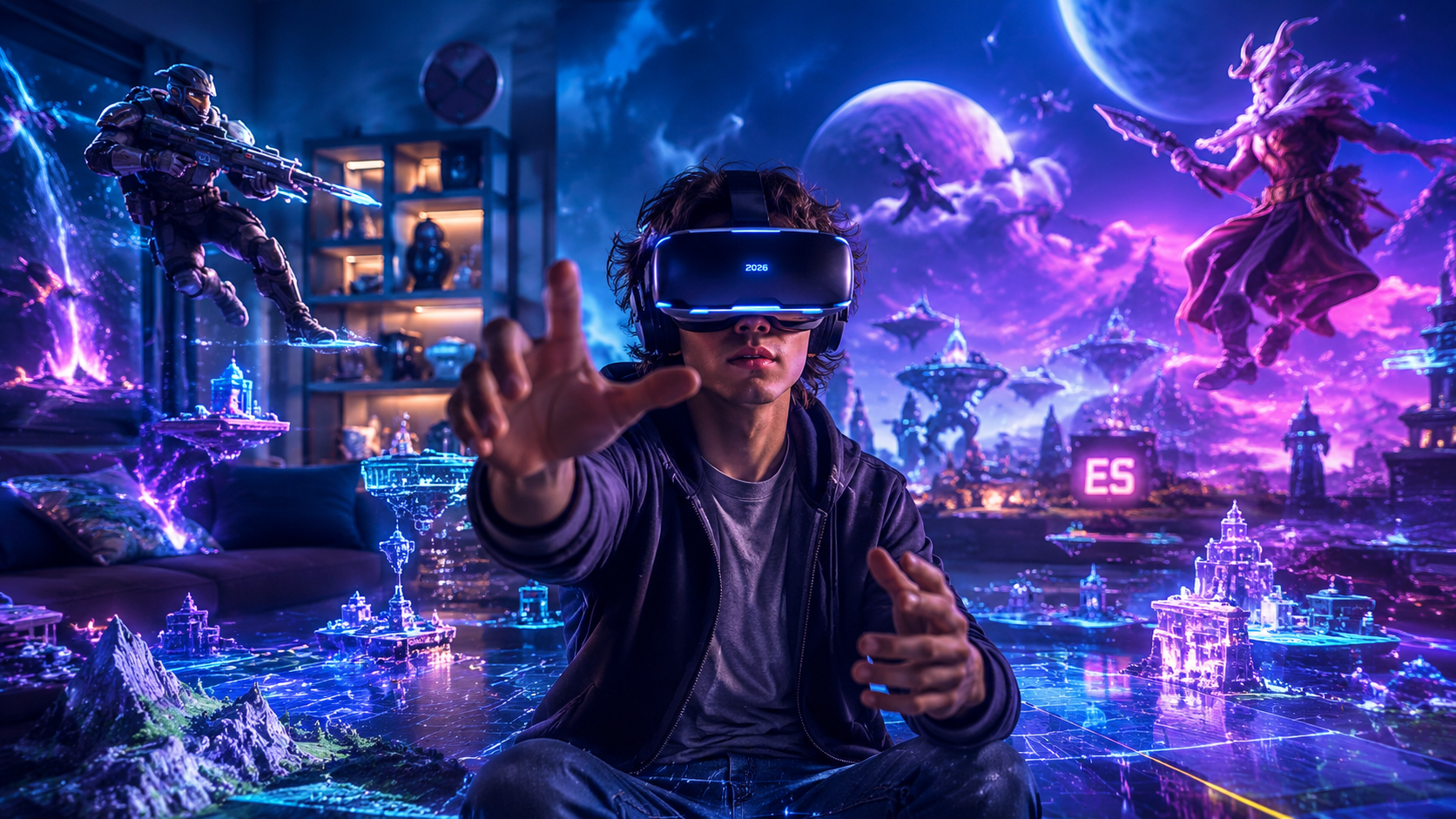
Best AI in Gaming 2026: Amazing New Era of Immersive Play

Best AI in Gaming 2026: A New Era of Immersive Play

By mid-2026, the world of video games has genuinely shifted in ways that go beyond better graphics. AI in gaming 2026 has produced game worlds that respond more dynamically to player decisions, characters that hold more natural conversations, and development tools that are making game creation accessible to smaller teams than ever before. I’ve been following these developments closely, and this guide covers what’s actually changed and why it matters for players and developers alike.

AI in Gaming 2026: Intelligent NPCs with Real Reasoning

The most meaningful practical change in AI in gaming 2026 is in how non-player characters behave. Rather than cycling through a fixed set of scripted dialogue options, modern NPC systems powered by language model-based reasoning can hold more open-ended conversations with players, remember past interactions, and respond in ways that feel more contextually appropriate to the specific game situation.

This is connected to the same AI reasoning advances we cover in our ChatGPT advanced features guide, applied specifically to the real-time constraints of gaming. The results vary by implementation, but the improvement over scripted dialogue trees is real and noticeable in games that have invested in this technology. The main practical limit is that truly open-ended conversation in games is computationally expensive and requires careful design to keep characters behaving in ways consistent with their role in the narrative.

Procedural World Building

Procedural generation of game content has been around for decades, but AI in gaming 2026 has expanded what’s possible. AI tools can now assist in generating not just terrain but more coherent architectural layouts, ecosystem behaviors, and adaptive narrative elements that respond to player choices over longer timescales. This means players in the same game can have genuinely different world experiences based on their choices and exploration paths.

For players, this translates to games with more replayability and less sense of hitting the same scripted content repeatedly. For developers, it means smaller teams can create content at a scale that would previously have required much larger production budgets.

AI-Enhanced Graphics and Upscaling

AI-powered graphics upscaling has become one of the most practically impactful developments in AI in gaming 2026. Technologies like NVIDIA’s DLSS and AMD’s equivalent FSR use neural networks to render frames at lower resolutions and reconstruct them at higher resolutions, achieving visual quality that approaches native high-resolution rendering at a fraction of the GPU processing cost. This has made higher visual fidelity accessible on mid-range hardware that wouldn’t otherwise be able to run games at those quality settings.

The current generation of these upscaling tools is meaningfully better than earlier versions, and the trend of AI-assisted rendering improving accessibility of high-quality graphics is well-established. Claims of “8K gaming on mid-range hardware” somewhat overstate where things are in practice, since performance varies significantly by scene complexity, but the underlying technology is real and impactful.

Personalized Gameplay and Difficulty Adaptation

AI in gaming 2026 has improved dynamic difficulty adjustment, where games monitor player performance and adjust challenge levels to keep the experience appropriately engaging rather than frustratingly hard or boringly easy. This kind of adaptive system has been around in simpler forms for years, but the implementation has become more sophisticated, using more signals about player behavior and adjusting more dimensions of the experience than just simple enemy health or damage numbers.

Cloud Gaming and AI Server-Side Processing

Cloud gaming has grown significantly in AI in gaming 2026, with AI on the server side handling increasingly complex physics, AI character behavior, and world simulation, then streaming the result to players on devices that don’t need to run these calculations locally. This does meaningfully lower the hardware barrier to accessing high-quality gaming experiences, though the experience still depends heavily on connection quality and latency, which varies significantly by location and connectivity.

AI Tools for Indie Game Development

One of the more exciting developments in AI in gaming 2026 for the broader creative ecosystem is how AI tools are lowering the barrier for small and indie studios. AI-assisted asset generation, automated bug testing, and AI-powered level design tools are letting small teams attempt scope that previously required much larger productions. The global gaming market has seen real growth in indie titles as these tools have become more accessible.

For developers in cities like Surat and Bangalore, this means that genuinely ambitious game projects are more feasible with smaller teams and budgets than they were a few years ago, which is contributing to more diverse voices and creative approaches in game development.

AI and Esports and Competitive Gaming

AI tools in esports contexts are worth mentioning: AI-based opponent systems for training, performance analysis tools that break down player behavior patterns, and AI-assisted coaching are all growing applications within competitive gaming. These tools help players identify patterns in their own gameplay and in opponents, which was previously only accessible to well-resourced professional teams.

What This Means for Players in India

For players in India, the most practically relevant AI in gaming 2026 improvements are in cloud gaming accessibility and NPC quality in AAA titles. Cloud gaming services mean that players without high-end hardware can access current-generation games at competitive quality levels, assuming good connectivity. As Personal AI Hardware continues to develop, the device landscape for gaming is also broadening.

Conclusion

AI in gaming 2026 has produced real improvements in NPC intelligence, procedural content, graphics rendering efficiency, and development tools for smaller studios. The changes that matter most for everyday players are the ones making game worlds feel more reactive and dynamic, and making high-quality gaming more accessible without requiring top-tier hardware. At aitutorial.in, we’ll keep following these developments. Check our Future of AGI guide for broader context on AI capability development and our list of Best AI Agents 2026 for more on the underlying technology.

Leave a Comment