
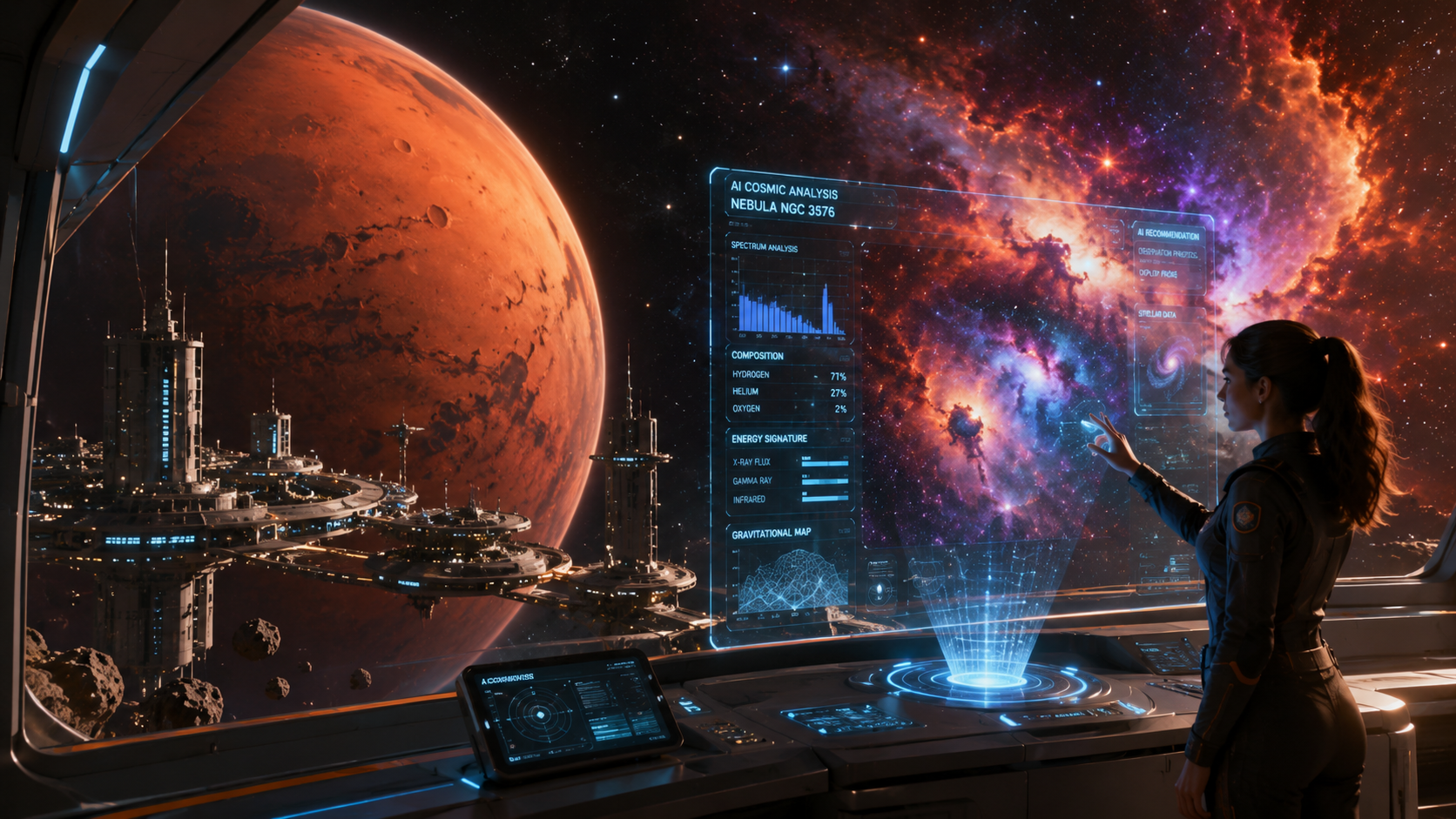
The Cosmic Frontier: AI Navigating the Solar System
Deep space exploration in 2026 involves astronomical data volumes that exceed human analytical capacity. From processing petabytes of spectroscopic data from space telescopes to navigating autonomous rovers across Martian terrain with multi-minute communication delays, artificial intelligence has become the essential computational backbone of modern astrophysics and aerospace engineering.
This technical overview explores how space agencies (NASA, ESA, ISRO) and commercial aerospace companies deploy AI across exoplanet discovery, spacecraft autonomy, and satellite orbital management.
Leading Applications of AI in Aerospace & Astronomy
| Aerospace Domain | AI Architecture | Mission Application | Primary Agency / Org |
|---|---|---|---|
| Exoplanet Discovery & Transit Analysis | Convolutional Neural Networks & Light Curve Filters | Filtering stellar noise from James Webb Space Telescope (JWST) light curves to detect candidate exoplanet atmospheres. | NASA Ames, Kepler/TESS Teams |
| Autonomous Planetary Navigation | AutoNav & Edge Vision Systems | Enables rovers (Perseverance, future Lunar rovers) to evaluate rock hazards and plan optimal traversal routes independently without Earth commands. | NASA JPL, ISRO |
| Orbital Debris Collision Avoidance | Predictive Orbital Mechanics & Reinforcement Learning | Autonomously executes thruster burns on low-Earth orbit satellites (Starlink, OneWeb) to avoid space debris collisions. | SpaceX, ESA Space Safety Centre |
| Cosmological Dark Matter Mapping | Graph Neural Networks (GNNs) | Simulating the gravitational lensing effects of dark matter distribution across billions of light years. | Euclid Consortium, Vera C. Rubin Observatory |
Frequently Asked Questions (FAQs)
Why is autonomy critical for deep space robotic missions?
Radio signals traveling from Mars or Jupiter take between 4 to 45 minutes to reach Earth. Real-time hazard avoidance requires rovers and landers to make immediate autonomous navigation decisions onboard.
How does AI identify biosignatures on distant exoplanets?
AI algorithms analyze transmission spectroscopy data, matching atmospheric chemical absorption spectra against simulated models to detect methane, oxygen, ozone, and water vapor signatures.