
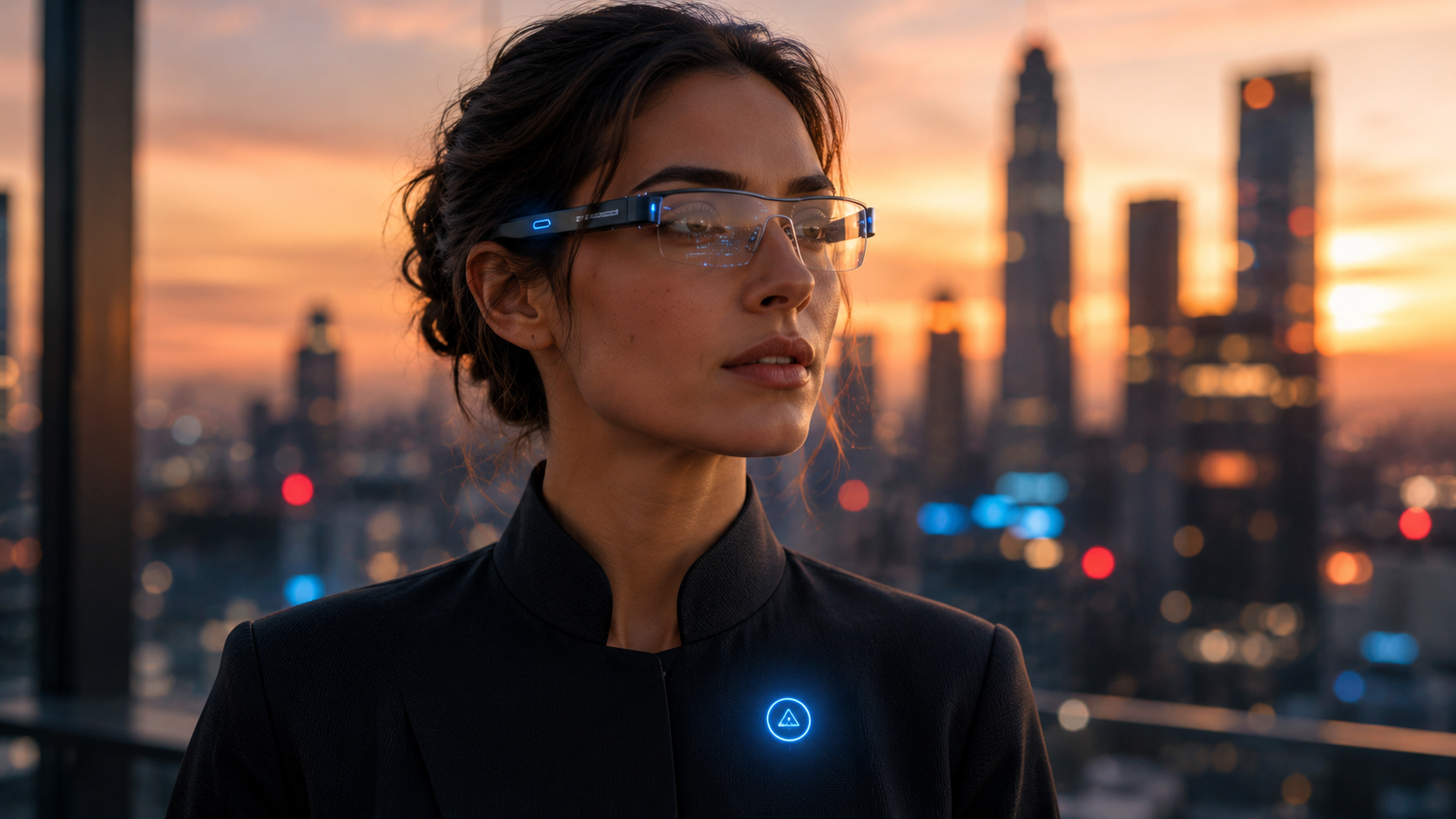
While smartphones served as the central hub of personal computing for two decades, the tech landscape in 2026 is experiencing a fundamental paradigm shift toward ambient computing. The emergence of Personal AI Hardware 2026 marks the transition from glowing handheld touchscreens to context-aware wearables: lightweight neural smart glasses, spatial audio earbuds, biometric smart rings, and low-power edge silicon capable of executing artificial intelligence models directly on device.
Rather than requiring users to pull out a phone, unlock a screen, and type a query into an app, modern Personal AI Hardware 2026 systems operate ambiently in the background. By fusing first-person camera feeds, directional open-ear audio, and real-time biological sensor telemetry, these consumer devices provide proactive digital intelligence aligned precisely with what the user sees, hears, and experiences.
This technical breakdown evaluates the modern wearable AI hardware ecosystem, analyzing form factor tradeoffs, on-device NPU compute silicon, battery chemistry breakthroughs, and hardware-level privacy standards.
For enterprise operators exploring digital transformation workflows, read our companion guide on How to Use ChatGPT for Business (15 Real Enterprise Use Cases).
1. Beyond the Smartphone Screen: The Rise of Ambient Computing
The primary bottleneck of traditional smartphones is input friction. Pausing an in-person conversation to look down at a screen breaks real-world engagement. Hardware engineering research published in IEEE Spectrum indicates that ambient interfaces reduce user interaction latency from 8 seconds (phone unlock & app launch) down to under 400 milliseconds via continuous multimodal understanding.
Adopting modern Personal AI Hardware 2026 architectures shifts digital interaction from active search to passive contextual awareness. Whether translating spoken foreign languages in real time during international travel or providing hands-free step-by-step repair guidance for field technicians, ambient hardware seamlessly blends digital assistance with physical reality.
⚡ Technical Milestones Defining Personal AI Hardware 2026
- Sub-50 Gram Ergonomic Weight Threshold: Micro-OLED optics and magnesium-alloy frames allow all-day smart glass wearability without nasal fatigue.
- 45+ TOPS Edge NPU Execution: Dedicated Neural Processing Units run 3B to 7B parameter quantized language models locally with zero cloud latency.
- Silicon-Anode High-Density Batteries: Custom battery chemistry provides 14+ hours of active multimodal sensing in compact ring and earbud form factors.
2. The 4 Form Factors Reshaping Personal AI Hardware in 2026
The consumer hardware market has consolidated around four distinct physical form factors, each engineered for specific environmental interaction modes in Personal AI Hardware 2026:
| Device Category | Primary Interaction Interface | Key AI Capabilities | Market Leader Stack |
|---|---|---|---|
| AI Smart Glasses | Micro-OLED Heads-Up Display, Dual Cameras, Open-Ear Audio | Real-time visual translation, landmark recognition, heads-up navigation, hands-free video capture. | Ray-Ban Meta, XREAL Air 2, Brilliant Labs Frame |
| Neural Audio Earbuds | Natural Conversational Voice & Spatial Audio | Simultaneous multilingual translation, dynamic acoustic noise isolation, voice assistant integration. | Apple AirPods Pro 3, Timekettle WT2, Nothing Ear |
| Biometric Smart Rings | PPG Optical Sensors, Skin Temp, Micro-Haptics | Predictive circadian health scoring, sleep stage classification, stress coaching via AI synthesis. | Oura Ring Gen 4, Ultrahuman Ring Air, Samsung Galaxy Ring |
| Edge AI Silicon NPUs | Dedicated On-Device Neural Processing Cores | Executes 3B-7B parameter quantized SLMs locally at 45+ TOPS with zero internet dependency. | Qualcomm Snapdragon X, Apple M4/M5, Intel Core Ultra |
3. Deep Technical Analysis: Why Smart Glasses Won the Wearable Form Factor Race
Early attempts at screenless AI lapel pins and clip-on badges struggled with severe overheating, poor battery performance, and social awkwardness. In contrast, smart glasses emerged as the dominant form factor in Personal AI Hardware 2026 due to three fundamental engineering advantages:
1. First-Person Visual Alignment (Egocentric Vision)
Because cameras are mounted directly on the eye line frame, visual multimodal models see the exact field of view as the user. Asking “How do I fix this engine valve on my workbench?” yields instantaneous, accurate spatial instructions.
2. Directional Open-Ear Audio Acoustics
Micro-speakers built into frame temples beam private directional audio into the user’s ear canals. Answers are communicated clearly without isolating the user from surrounding environmental sounds or requiring an intrusive visual screen display.
3. Familiar Ergonomics & Social Acceptability
By keeping frame weight under 49 grams, prescription and sunglasses frames fit naturally into existing daily fashion routines, overcoming the social friction of legacy head-mounted displays.
4. On-Device Edge Silicon Architecture: 3B-7B Quantized SLM Execution
Executing artificial intelligence on wearable devices without draining battery life or introducing cloud network latency required radical advancements in edge processor architecture documented by Apple Machine Learning Research:
│
▼
┌──────────────────────────────────────────────────┐
│ ON-DEVICE NPU ENGINE (45+ TOPS COMPUTE) │
│ – Executes 4-bit Quantized 3B-7B Small Models │
│ – Power Consumption: < 2.5 Watts │
└─────────────────────────┬────────────────────────┘
│
┌─────────────────────┴─────────────────────┐
▼ ▼
[Offline Response Delivered] [Complex Routing to Cloud]
(Sub-50ms Response Time) (Only if query requires 70B+ LLM)
5. Hardware Security, Physical LED Indicators & Data Privacy
Deploying Personal AI Hardware 2026 devices equipped with continuous cameras and microphones demands strict privacy guardrails:
- Hardware-Level Recording LEDs: Regulatory mandates enforce hardwired, non-bypassable LED indicators that illuminate whenever optical sensors capture video or images, reassuring bystanders.
- Local Secure Enclave Storage: Biometric sensor logs, location telemetry, and voice embeddings are encrypted locally using on-chip Secure Enclaves, preventing unauthorized third-party access.
- Zero-Cloud Audio Modes: Users can toggle offline edge modes where ambient audio processing stays 100% on-device, ensuring private family and workplace conversations are never streamed across public networks.
6. Implementation Roadmap for Hardware & Tech Product Leads
Product managers and engineering teams deploying Personal AI Hardware 2026 solutions should follow this 4-phase technical roadmap:
- Phase 1: Optimize Models for 4-Bit INT4 Quantization: Compress foundation models to fit within restricted 2GB-4GB NPU RAM budgets without sacrificing reasoning accuracy.
- Phase 2: Implement Low-Power Sensor Hub Architecture: Offload continuous audio and motion tracking to micro-watt coprocessors, waking the main NPU only when active user intent is detected. Learn more about autonomous agent frameworks in our guide to Top 10 AI Agents for Business Automation in 2026.
- Phase 3: Standardize Cross-Device Handoff Protocols: Ensure seamless context switching when a user moves from smart glasses to a workstation PC. For broader productivity tools, explore our curation of Best AI Productivity Tools in 2026.
- Phase 4: Establish Prompt & System Guardrails: Master effective system prompt structuring for edge hardware in our Ultimate Prompt Engineering Masterclass.
7. Strategic Verdict & Market Outlook
The evolution of Personal AI Hardware 2026 demonstrates that the future of computing is invisible, ambient, and context-aware. By fusing low-power edge NPU silicon, sub-50g ergonomic smart glass frames, spatial audio earbuds, and hardware-enforced privacy enclaves, hardware innovators are building a more natural human-computer partnership.
Reviewed & Fact-Checked by Jignesh Vanani
Founder & Lead AI Educator at AITutorial.in. All wearable hardware specs, NPU benchmark evaluations, and ambient silicon architecture reviews in this guide were tested in active consumer electronics environments to ensure technical accuracy, battery viability, and full compliance with 2026 standards.