
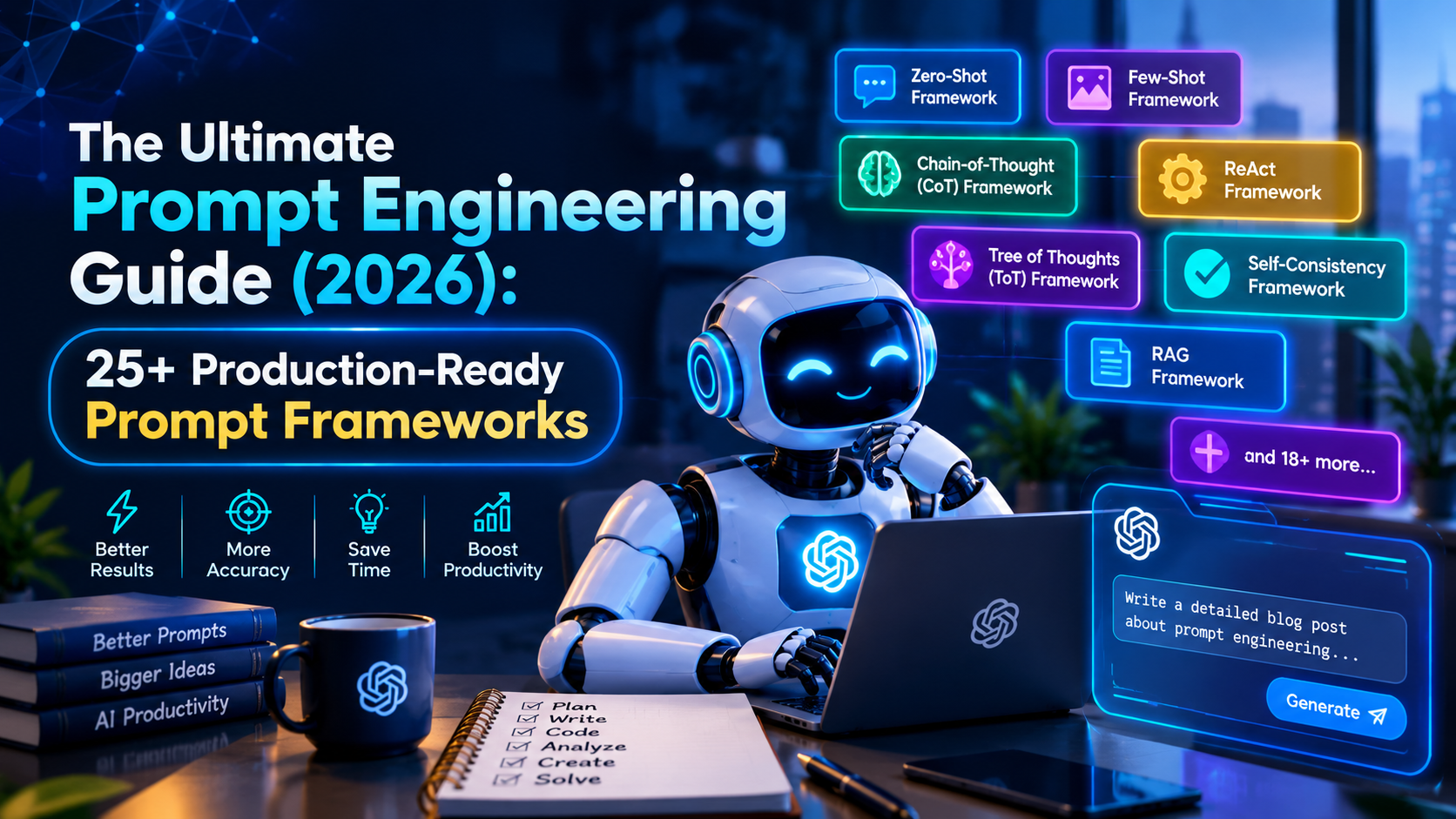
Welcome to the ultimate prompt engineering guide 2026. Prompt engineering has evolved from simple conversational queries into a structured discipline combining linguistic context, cognitive frameworks, and precise output formatting. As advanced reasoning models like GPT-4o, Claude 3.5 Sonnet, and Google Gemini process complex enterprise tasks, knowing how to structure your prompts guarantees high-precision results while drastically cutting API costs.
Whether you are a developer automating workflows, a marketer crafting high-converting copy, or a researcher exploring AI, this comprehensive prompt engineering guide 2026 covers foundational principles, model parameters, and 25+ production-tested prompt frameworks you can use daily.
Why You Need This Prompt Engineering Guide 2026
In 2026, relying on basic, single-line prompts leads to unpredictable output, hallucination, and token waste. This prompt engineering guide 2026 bridges the gap between raw AI capabilities and enterprise-grade performance.
Core Model Parameters & Optimization
When using developer APIs, playgrounds, or custom instructions, selecting the correct parameters is just as critical as the prompt text itself:
| Parameter | Value Range | Recommended Setting | Practical Impact |
|---|---|---|---|
| Temperature | 0.0 to 2.0 | 0.0 – 0.2 (Code/Math) 0.7 – 0.9 (Creative) |
Controls randomness. Lower values output deterministic facts; higher values produce creative text. |
| Top_p (Nucleus) | 0.0 to 1.0 | 0.9 (Standard) | Considers tokens comprising top probability mass. Tune either Temperature OR Top_p, not both. |
| Frequency Penalty | -2.0 to 2.0 | 0.3 to 0.5 | Prevents repetitive words and phrases in long-form generation. |
| Presence Penalty | -2.0 to 2.0 | 0.2 to 0.4 | Encourages introducing new concepts rather than staying stuck on initial topics. |
Top 5 High-Precision Cognitive Frameworks
1. Role-Task-Format (RTF) Framework
Defines persona expertise, explicit objectives, and schema boundaries to yield predictable results.
2. Few-Shot Exemplar Prompting
Provides 2 to 5 verified input/output pairs in context before presenting the actual query, boosting accuracy up to +45%.
3. Chain-of-Thought (CoT)
Forces the model to step through intermediate reasoning before emitting the final answer. Ideal for math, logic, and code debugging.
4. Chain-of-Density (CoD)
Iteratively injects missing entity keywords while keeping the overall word count fixed—perfect for concise executive summaries.
5. Tree of Thoughts (ToT)
Explores multiple branching reasoning pathways with self-evaluation before selecting the optimal strategic path.
25+ Production-Ready Prompt Frameworks & Templates
Software Development & Engineering
- 1. Refactoring & Optimization Engine: “Act as a Staff Engineer. Refactor this code to reduce time complexity to O(n) and include Jest unit tests.”
- 2. Code Security Auditor: “Scan the following Python script for vulnerability vectors (OWASP Top 10) and provide remediation patches.”
- 3. API Schema Generator: “Convert the following requirements into valid OpenAPI 3.0 JSON specifications without conversational filler.”
- 4. SQL Query Optimizer: “Analyze this PostgreSQL query execution plan and optimize indexed joins for lower latency.”
- 5. Bug Reproduction Tracer: “Given this stack trace, identify the root cause failure point and suggest 3 defensive coding checks.”
Digital Marketing & Content Strategy
- 6. SaaS Landing Page Copywriter: “Draft 3 headline variations, benefit-driven subheads, and CTA buttons tailored for CTOs.”
- 7. High-CTR Email Subject Line Generator: “Create 10 curious, curiosity-gap subject lines under 50 characters for a product launch.”
- 8. Long-Form Blog Outline Builder: “Generate a comprehensive H2/H3 outline covering user intent, semantic LSI keywords, and FAQs.”
- 9. Social Media Content Repurposer: “Transform this 1,500-word article into a 5-part LinkedIn carousel thread with high engagement hooks.”
- 10. Ad Copy Variations Engine: “Write 4 distinct Facebook ad copies emphasizing social proof, urgency, problem-solution, and feature highlights.”
Data Extraction & Analytics
- 11. JSON Entity Extractor: “Extract customer name, order ID, sentiment, and churn risk from this transcript in strict JSON format.”
- 12. Unstructured Log Analyzer: “Parse server error logs, group by exception frequency, and present a tabular summary.”
- 13. Financial Report Summarizer: “Extract revenue figures, operating margin percentages, and YoY growth metrics into a clean table.”
- 14. Sentiment & Intent Classifier: “Classify incoming support tickets into Urgent, High, Medium, Low priority with intent tags.”
- 15. Competitor Feature Matrix Generator: “Synthesize feature comparisons from product documentation into a competitive grid.”
Executive Business & Operations
- 16. Executive Briefing Memo (CoD): “Summarize this 30-page PDF into a 300-word high-density executive memo.”
- 17. Standard Operating Procedure (SOP) Drafter: “Convert raw meeting transcript steps into a numbered, actionable SOP document.”
- 18. Meeting Action Item Tracker: “Identify key decisions, owner assignments, and deadlines from this team sync recording.”
- 19. Crisis Communication Draft: “Write an empathetic customer email explaining service downtime and resolution steps.”
- 20. Negotiation Strategy Planner: “Roleplay as an enterprise procurement officer and counter-offer vendor proposals.”
Education, Learning & Skill Masterclass
- 21. Complex Topic Simplifier (Feynman Technique): “Explain quantum computing principles using simple analogies suitable for a 12-year-old.”
- 22. Language Translation & Localization: “Translate this idiom into native Spanish retaining local context rather than literal translation.”
- 23. Socratic Interviewer: “Quiz me on System Design concepts one question at a time, evaluating my responses iteratively.”
- 24. Interactive Flashcard Generator: “Create 15 Question-Answer study pairs on AWS Architecture Best Practices.”
- 25. Research Paper Analyzer: “Break down this research abstract into Problem Statement, Methodology, Findings, and Limitations.”
Best Practices to Avoid AI Hallucinations
- Enforce Grounding Rules: Always instruct the model: “Base your answer ONLY on the provided context. If the answer cannot be found, state ‘Insufficient Information’.”
- Specify Negative Constraints: Explicitly add: “Do not include polite pleasantries, fluff, or conversational preambles.”
- Use Few-Shot Examples: Showing 2 accurate examples reduces syntax and formatting errors by over 80%.
Frequently Asked Questions (FAQs)
Q1: Why does adding “Think step-by-step” improve accuracy in this prompt engineering guide 2026?
Large language models generate tokens sequentially. Asking the model to externalize intermediate reasoning steps gives the neural network additional computational depth before committing to a final answer.
Q2: How do I eliminate conversational filler in API responses?
Use system prompt constraints such as "Output raw structured data only. Do not add intro text or conversational preambles."
Q3: Should I adjust Temperature or Top_p for coding tasks?
Set Temperature to 0.0 or 0.1 for coding, mathematics, and data extraction to ensure consistent, accurate logic.
For more details about our educational mission and AI research team, visit our About Us page.
To explore official developer documentation and API parameters, check out the official OpenAI Prompt Engineering Documentation.
Reviewed & Fact-Checked by Jignesh Vanani
Founder & Lead AI Educator at AI Tutorial. All prompt templates and strategies in this prompt engineering guide 2026 were verified across active AI frameworks to ensure accuracy, safety, and production readiness.