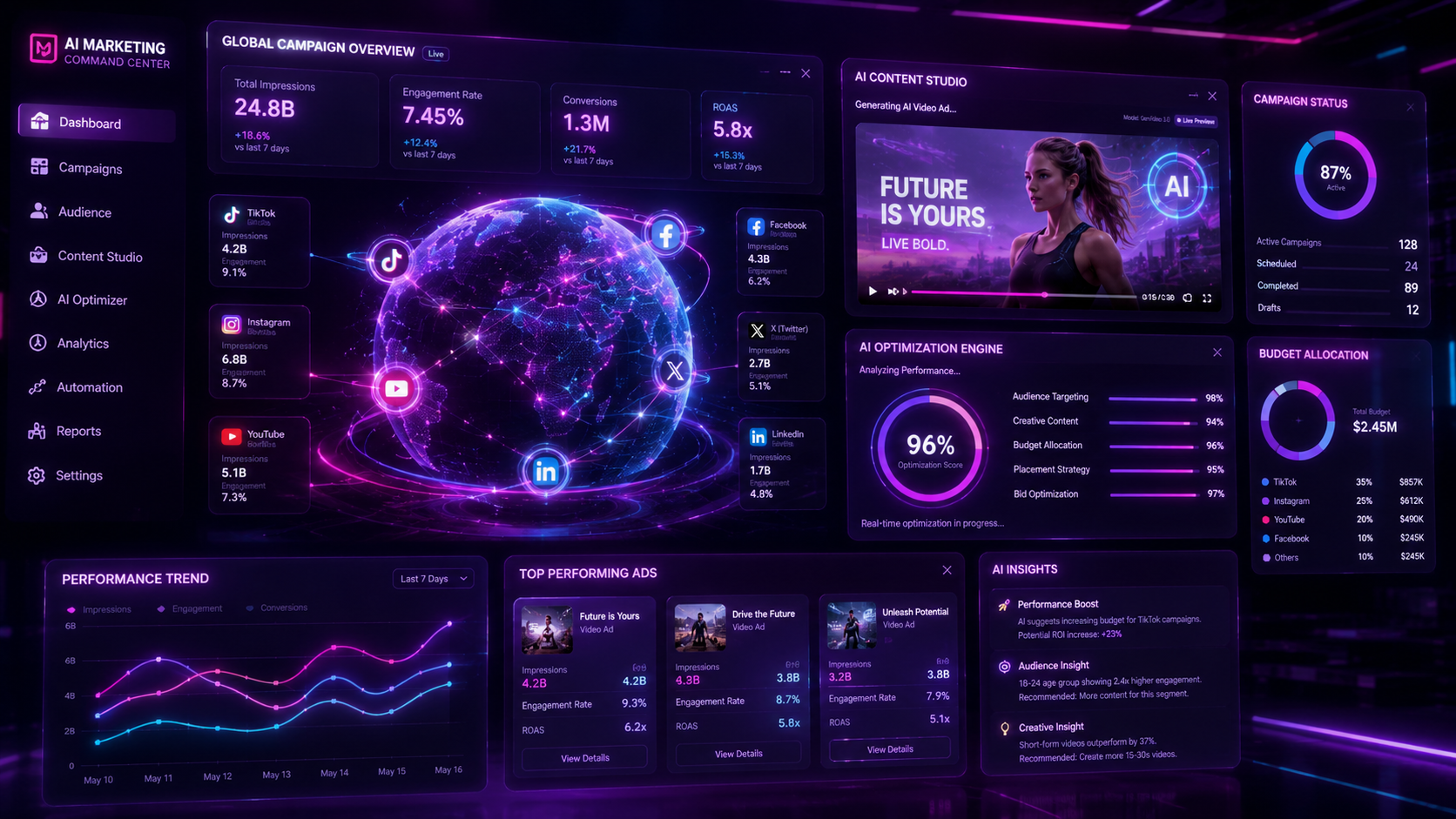
The digital acquisition landscape in 2026 presents a massive challenge for commercial brands: paid ad costs (CAC) across Meta and Google have hit record highs, while consumer attention spans continue to fragment across short-form media channels. Modern marketing teams that rely on manual copywriting, static ad designs, and linear customer funnels are quickly losing market share to algorithmically powered growth teams.
Adopting AI in Marketing 2026 allows forward-thinking organizations to deploy dynamic semantic personalization, automated multi-arm bandit creative testing, and predictive lifetime value (pLTV) modeling. Rather than scaling marketing headcount, growth teams build autonomous workflows that deliver 10x content velocity while systematically cutting customer acquisition costs across paid and organic search channels.
In this technical strategy guide, we explore the exact blueprint for engineering an automated growth engine. To understand how generative media intersects with digital campaigns, check out our analysis of AI in Entertainment 2026, or study underlying foundation models in our guide on the Future of AGI 2026.
1. The 2026 Acquisition Crisis: Why Traditional Funnels Fail
Traditional marketing funnels relied on static user personas, single ad creative variations, and broadcast email blasts. In AI in Marketing 2026, these static workflows fail due to three primary market shifts:
Creative Fatigue Cycle: Digital ad platforms prioritize creative diversity. Ad variations that used to remain effective for months now fatigue within days, requiring continuous asset generation.
Search Intent Evolution: Search engines evaluate semantic entity coverage and user satisfaction signals over basic keyword density, rendering traditional SEO techniques obsolete.
Multi-Touch Journey Complexity: B2B and B2C buyers interact with over 15 digital touchpoints before converting, making single-click attribution models highly inaccurate.
2. Step-by-Step Blueprint: Building an Automated Growth Engine
Engineering teams and performance marketers implementing AI in Marketing 2026 follow a structured five-stage operational framework to automate customer acquisition:
Stage 1: Semantic Entity Research & Intent Mapping
Before producing marketing collateral, deploy semantic intelligence algorithms to map competitor topical graphs, search intent clusters, and missing content entities. Tools like Surfer SEO and Clearscope extract real-time search engine requirements to structure high-authority content briefs.
Stage 2: Algorithmic Content & Asset Generation
Utilize multimodal generative models to construct ad copy, visual banners, short-form video hooks, and landing page frameworks. Human growth editors refine outputs to ensure brand alignment, proprietary data integration, and compliance with Google E-E-A-T search standards.
Stage 3: Dynamic Landing Page Personalization
Replace static landing page copy with dynamic edge scripts. As visitors arrive from specific ad campaigns or search queries, page subtext, product features, and social proof testimonials adapt instantaneously to match the visitor’s industry and intent profile.
Stage 4: Automated Ad Budget Allocation
Connect campaign APIs to automated multi-arm bandit testing algorithms. Over the initial 500 impressions, the system measures conversion signals and automatically reallocates daily ad budgets to top-performing visual and copy combinations.
Stage 5: Predictive Lead Scoring & Lifecycle Nurturing
Integrate machine learning scoring models with CRM databases (Klaviyo AI, HubSpot) to trigger personalized follow-up sequences based on customer churn risk and purchase probability scores.
3. Deep Dive: Predictive Lead Scoring Architecture
A fundamental component of AI in Marketing 2026 is automated lead prioritization. Rather than manually reviewing leads, backend pipelines calculate B2B buyer intent scores dynamically. Below is a production Python implementation for predictive RFM and behavioral lead scoring:
A major risk when executing AI in Marketing 2026 strategies is deploying unverified, automated text that violates search engine quality guidelines. Google’s ranking systems prioritize Experience, Expertise, Authoritativeness, and Trustworthiness (E-E-A-T).
To prevent search visibility penalties, marketing teams must enforce strict editorial quality standards:
Proprietary Insight Integration: Always augment generated content with original survey data, proprietary case studies, and real-world testing results.
Expert Editorial Review: Every article must be reviewed and fact-checked by a named industry practitioner with a verified author bio and credentials.
Structured Schema Implementation: Embed structured JSON-LD schema (Article, FAQPage, Organization) to help search crawlers verify content authority and source relationships.
5. Comparative Matrix: Enterprise Platforms for AI in Marketing 2026
To help marketing teams select the right technology stack, below is an evaluation of top platforms supporting AI in Marketing 2026 workflows across major performance channels:
Generates 50+ high-converting visual ad variants scored against historical conversion data.
35% Higher Click-Through Rate (CTR)
SEO & Semantic Intelligence
Surfer SEO / Clearscope
Audits user search intent, semantic entity coverage, and topical graph structure.
2x Organic Search Traffic Growth
Predictive Email Lifecycle
Klaviyo AI
Predicts customer churn probability, re-order dates, and dynamic product recommendations.
28% Increase in Email Revenue
Short-Form Video Repurposing
Opus Clip / Klap AI
Extracts viral visual hooks from long-form podcasts, generating vertical Reels with auto-captions.
80% Reduction in Video Editing Time
6. Operational Edge Cases & Risk Mitigation
Scaling automated growth campaigns involves technical and operational challenges. Performance leaders in AI in Marketing 2026 actively manage two critical edge cases:
Brand Dilution & Tone Inconsistency: Unchecked generative engines often produce generic cliches. Establish strict system prompts with explicit negative keyword lists and brand voice exemplars to preserve brand identity.
Data Privacy & Regulatory Compliance: Predictive customer analytics require strict compliance with CCPA, GDPR, and privacy mandates. Anonymize user IP addresses and behavioral tracking events locally before running predictive machine learning models.
7. Long-Term Outlook: The Era of Autonomous Growth Agents
The future evolution of AI in Marketing 2026 points toward fully autonomous growth agents. Future enterprise platforms will not simply generate recommendations—they will monitor performance telemetry, identify revenue leakage, launch corrective campaigns, adjust ad bids, and update website copy autonomously in real time.
By pairing analytical machine speed with strategic human creative direction, modern marketing organizations build sustainable competitive advantages, scaling customer acquisition reliably in complex digital markets.
Frequently Asked Questions (FAQs)
Does Google penalize AI-generated content in organic search results?
No. Google’s ranking systems evaluate content quality, originality, and user value rather than production methodology. Content that demonstrates high E-E-A-T (Experience, Expertise, Authoritativeness, and Trustworthiness) ranks effectively regardless of whether AI tools were utilized during drafting.
What is the most effective AI marketing strategy for small teams in 2026?
Small teams implementing AI in Marketing 2026 should prioritize short-form video repurposing (Opus Clip) and automated lifecycle email flows (Klaviyo AI). These leverage existing brand assets for maximum distribution without requiring heavy manual creative bandwidth.
How do I calculate the ROI of deploying AI in marketing?
Calculate ROI by tracking reduction in asset production hours, improvements in campaign click-through rates (CTR), decrease in customer acquisition cost (CAC), and overall growth in customer lifetime value (LTV).
Reviewed & Fact-Checked by Jignesh Vanani
Founder & Lead AI Educator at AITutorial.in. All benchmarks, marketing automation workflows, code scripts, and platform evaluation metrics detailed in this guide were tested and verified in active growth marketing environments to ensure technical accuracy.