Best AI in Education 2026: How Learning Is Changing
Looking at classrooms around India today, the shift from a few years ago is genuinely noticeable. By mid-2026, AI tools have moved from experimental pilots in a handful of schools to a more widespread presence in how students learn and teachers work. I’ve been observing several AI-integrated educational setups recently, and while the reality is more nuanced than the most enthusiastic marketing claims, the genuine improvements in personalized learning support are worth covering honestly.
This guide on AI in education 2026 covers what’s actually working for students and teachers, alongside realistic context about where challenges and limitations remain.
AI in Education 2026: Personalized Learning Paths
One of the more significant developments in AI in education 2026 is the improvement in adaptive learning systems that adjust the difficulty, format, and pacing of content based on how individual students are actually progressing. Rather than every student moving through identical material at the same speed, these systems can identify where a particular student is struggling or excelling and adjust accordingly.
In practice, the best implementations of this approach have shown genuine improvements in student engagement and outcomes for specific subjects and age groups, particularly for well-structured subjects like math and language learning where progress is measurable and content can be meaningfully branched. The effectiveness varies more for open-ended subjects requiring synthesis and creativity, where AI has a harder time calibrating what “mastery” looks like.
AI Teaching Assistants and 24/7 Support
AI teaching assistants have become genuinely useful tools for both administrative support and student help. On the administrative side, tools that handle grading of structured assignments, attendance tracking, and progress reporting free up meaningful teacher time for higher-value work like direct mentorship and one-on-one support. As we discuss in our Best AI Agents guide, these agents work well for clearly defined, repeatable tasks.
For students, 24/7 AI tutoring tools that can explain concepts, work through problems step by step, and provide immediate feedback have meaningfully improved access to academic support, particularly for students who don’t have access to expensive private tutoring. The quality varies by subject and tool, and it’s still worth encouraging students to verify AI explanations against course materials and teachers rather than treating AI responses as always correct.
Immersive Learning with VR and AI
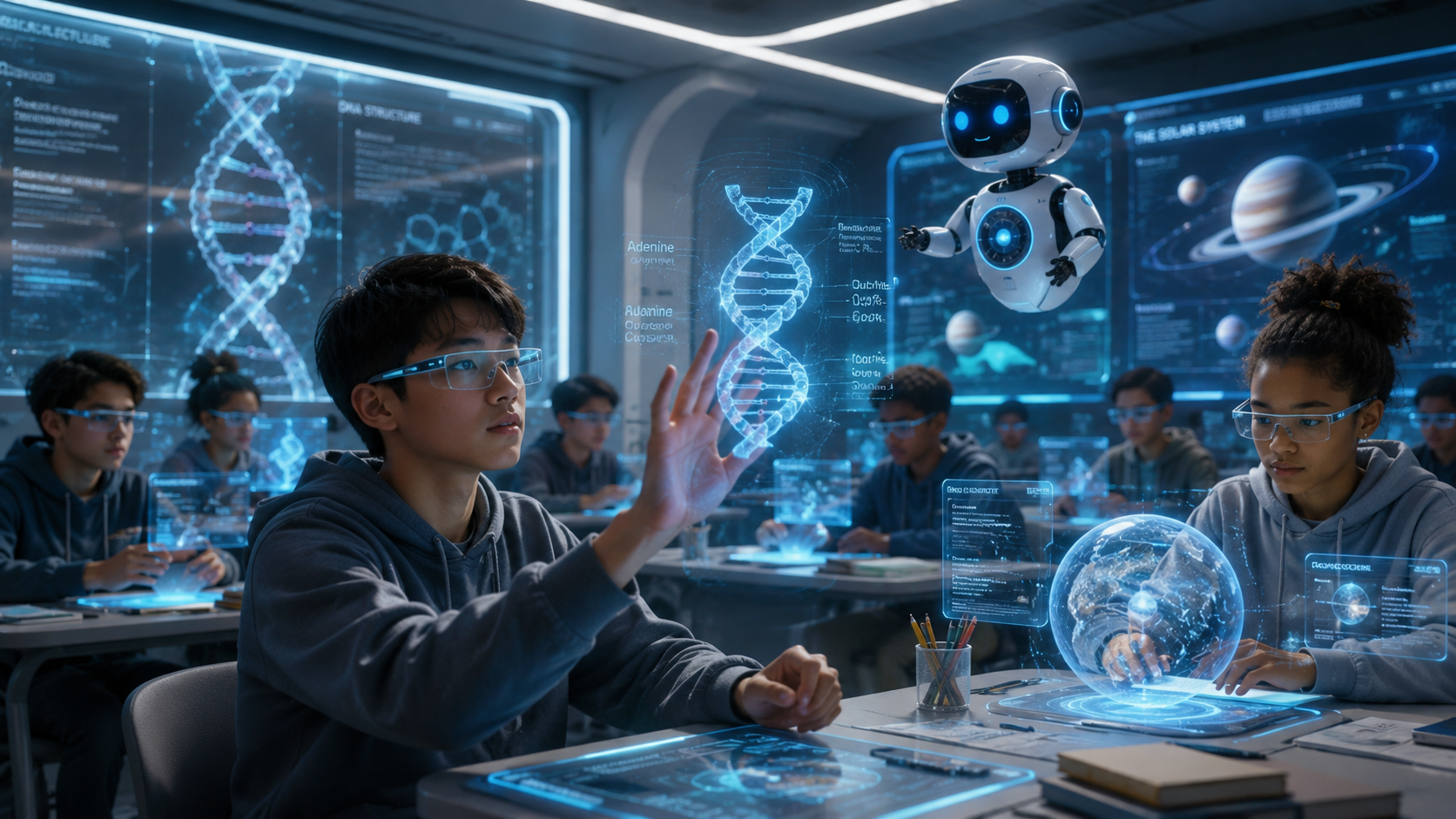
The combination of AI and VR for immersive educational experiences is an active and genuinely promising area in AI in education 2026. AI-guided virtual environments that let students explore historical periods, biological systems, or physical phenomena in interactive 3D have real educational potential, particularly for subjects where visualization significantly aids understanding.
Mainstream adoption is still uneven: well-resourced urban schools have more access to VR hardware and integrated AI content than rural schools, which is a genuine equity concern worth acknowledging. The direction is positive, but the technology reaching students across India uniformly is still a work in progress.
Skills Assessment and Career Guidance
AI-driven continuous assessment tools are changing how student progress is measured and documented. Rather than relying entirely on point-in-time exams, these platforms track skill development over time and build more comprehensive pictures of what a student can actually do. This approach has real advantages for identifying learning gaps earlier and for producing credentials that reflect demonstrated skills rather than just exam performance.
AI-powered career guidance tools that suggest pathways based on student strengths and interests are also becoming more sophisticated, though they work best as one input among several in a career exploration conversation rather than definitive prescriptions.
Ethical Challenges and Digital Literacy
The rise of AI in education 2026 brings genuine ethical challenges worth taking seriously. As we discuss in our AI ethics guide, teaching students digital literacy now means teaching them to think critically about AI-generated content, understand AI bias, and maintain original thought rather than over-relying on AI tools for work that’s meant to develop their own skills.
Student data privacy is also a significant concern. Educational AI systems collect detailed data about learning patterns, performance, and behavior, and schools need to be clear with students and parents about how that data is used and protected. Ensuring equal access to AI education tools across economic and geographic divides is an ongoing challenge that policy and funding decisions need to address.
AI-Driven Professional Development for Teachers
AI in education 2026 is also changing how teachers develop professionally. Tools that analyze classroom interactions (with appropriate consent and privacy safeguards) and provide feedback on teaching approaches, identify students who may need additional support, or suggest differentiated instruction strategies are genuinely useful for teachers willing to engage with them.
The most effective implementations treat these tools as a resource for teacher professional judgment rather than a replacement for it. Teachers who understand what the AI is doing and why tend to use the feedback more productively than those who treat it as a scoring system to optimize.
What This Means for Indian Schools and Students
For India specifically, where educational access and quality vary enormously across regions, AI in education 2026 has real potential to help bridge some gaps, particularly through affordable AI tutoring tools accessible on basic smartphones. NCERT’s digital learning resources represent one example of how established educational institutions are integrating digital tools at scale.
The biggest near-term practical benefits for students in India are likely in AI-assisted exam preparation, language learning support, and access to quality explanations in regional languages, rather than the full immersive VR experiences that require more expensive hardware.
Conclusion
AI in education 2026 is genuinely improving personalized learning, expanding access to tutoring support, and reducing administrative burden for teachers, while the most ambitious visions of fully individualized AI education for every student everywhere are still developing rather than fully realized. At aitutorial.in, we’re committed to helping students and educators navigate these tools practically. Check our AI for Students guide for specific tools and our ChatGPT advanced features guide for the latest in AI reasoning tools useful for education.