
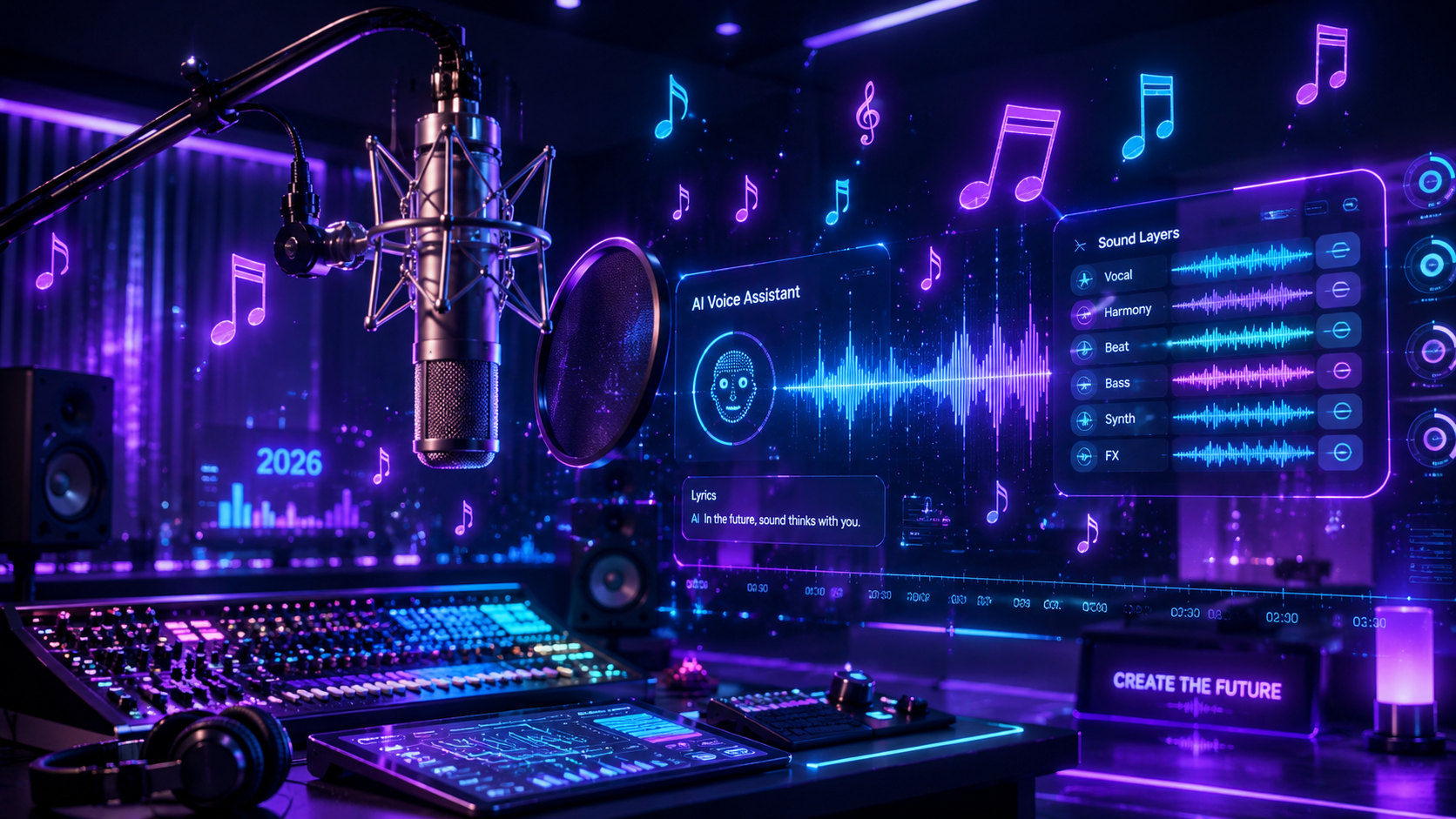
Music composition and audio production in 2026 have entered a revolutionary era of creative synthesis. Modern neural audio generation architectures generate complete broadcast-quality songs—including multi-instrumental arrangements, expressive human vocal performances, and complex genre crossovers—from natural language text prompts in seconds. Professional audio engineers, independent songwriters, film scoring composers, and content creators leverage AI in Music 2026 tools to streamline creative ideation, isolate stem tracks, and produce commercial audio tracks at unprecedented speed.
In this technical audio production masterclass on AI in Music 2026, we benchmark leading generative audio platforms, explore neural stem separation algorithms, break down Digital Audio Workstation (DAW) integration workflows, and analyze global music copyright licensing standards.
The Evolution of Neural Audio Synthesis
Historically, digital music creation relied on manual MIDI sequencing, virtual instrument sample libraries, physical studio recording, and complex mixing/mastering processing chains. Achieving professional radio-ready sound required thousands of dollars in studio equipment and years of sound engineering experience.
Generative audio models have transformed this landscape by operating on continuous raw audio waveforms and latent acoustic embeddings. Modern music foundation models understand musical theory, harmony structures, song dynamics (verse, chorus, bridge, outro), vocal vibrato, and instrument timbre natively, generating coherent 4-minute stereo compositions from descriptive text prompts.
Top AI Music Generation Platforms Compared
Below is an enterprise evaluation matrix ranking leading music synthesis and sound engineering platforms across key production domains:
| Software Platform | Audio Quality & Fidelity | Core Musical Superpower | Primary Production Use Case |
|---|---|---|---|
| Suno (v3.5 / v4) | High Broadcast Stereo (44.1kHz) | Coherent song structures, catchy vocal hooks, automated verse-chorus transitions. | Pop/Rock songwriting, background scores, commercial jingles. |
| Udio | Audiophile Ultra-Fidelity | Rich complex harmonies, granular track inpainting, precise prompt weight controls. | Jazz, classical, EDM, and nuanced acoustic genre production. |
| LALAL.AI / RipX DAW | Pristine 24-bit Lossless Stems | Neural stem isolation separating vocals, drums, bass, and synths without phase artifacts. | Remixers, sampling producers, and audio mastering engineers. |
| AIVA | Multi-Track MIDI Export | Generates editable MIDI files compatible with Logic Pro, Ableton Live, and FL Studio. | Film score composers, video game soundtracks, and orchestral arrangers. |
| ElevenLabs Music & Vocal | Studio Vocal Cloning | Clones custom vocal timbres with realistic emotional cadence and multilingual lyrics. | Voiceover artists, vocal tuning, and virtual artist development. |
1. Full Song Generation: Suno vs. Udio
The two leading generative music engines, Suno and Udio, serve different creative needs depending on the producer’s goal. Suno excels at creating complete, structurally sound pop, rock, and hip-hop songs with memorable vocal melodies and natural lyrical phrasing on the first attempt. To test full-song creation, visit the official Suno AI music portal.
Udio provides deeper granular control for experienced music producers. It allows creators to extend songs section-by-section, modify specific lyric lines via audio inpainting, and specify detailed musical parameters such as tempo BPM, key signatures, and vintage microphone modeling.
2. Neural Stem Separation & DAW Integration
Generating a complete stereo audio file is helpful for background music, but professional producers need individual track stems (vocals, drums, bass guitar, synths) to mix and master songs inside Digital Audio Workstations (DAWs) like Ableton Live, Logic Pro, or FL Studio.
Modern neural stem separation tools use deep convolutional networks trained on multi-track master tapes. When a producer feeds an AI-generated song into stem isolation software, the neural network separates the mixed stereo wave into pristine, isolated WAV tracks with zero phase cancellation or audible bleeding. Producers can then apply custom EQ, compression, reverb, and sidechaining directly inside their DAW environment.
3. AI Vocal Synthesis & Custom Vocal Cloning
Vocal production has traditionally been the most time-consuming phase of record production. AI vocal synthesis engines allow producers to generate expressive lead and backing vocals directly from written lyric sheets and MIDI melody lines.
Advanced vocal cloning platforms allow artists to train custom neural vocal models on their own recorded voice samples. Songwriters can draft demo vocal ideas in their home studio, and the AI converts the performance into a polished, professional lead vocal line matching any target vocal range or genre style. To learn how creators build viral background soundtracks for video content, read our guide on AI for social media 2026 video workflows.
4. MIDI Composition & Orchestral Scoring with AIVA
For film score composers and game audio designers, pure audio generation can feel restrictive because individual notes cannot be edited. Symbolic AI platforms like AIVA solve this by generating raw MIDI data rather than rendered audio waves.
AIVA analyzes centuries of classical and orchestral scores, outputting multi-track MIDI files containing separate tracks for violins, brass, woodwinds, and percussion. Composers import the MIDI file into their DAW and assign high-end virtual instrument libraries (like Spitfire Audio or Native Instruments) for complete sonic control.
Copyright, Commercial Monetization & Royalties
Navigating commercial ownership rights for AI-generated music requires understanding current platform terms and copyright laws:
- Commercial Monetization Rights: Paid subscribers on platforms like Suno and Udio receive commercial ownership rights, allowing track distribution to Spotify, Apple Music, YouTube Content ID, and TV/film sync licensing libraries.
- Copyright Eligibility: In most major jurisdictions, purely machine-generated audio files without human modification cannot be registered for traditional copyright protection. However, tracks combining human-written lyrics, original vocal tracks, and heavy DAW stem mixing qualify for full copyright protection.
- Artist Likeness Protection: Using AI to clone an artist’s voice without explicit legal authorization violates publicity rights and commercial trademark laws.
Frequently Asked Questions (FAQs)
Q1: Can I legally monetize music created with Suno or Udio on Spotify?
Yes! Paid subscribers on Suno and Udio receive commercial ownership rights to their generated tracks, enabling distribution to streaming platforms (Spotify, Apple Music) and commercial sync licensing.
Q2: Can professional producers edit individual instrument tracks from AI songs?
Yes. By running generated songs through AI stem separation tools (like LALAL.AI or RipX), producers extract clean individual WAV stems (vocals, drums, bass, synth) into their DAW for professional mixing and mastering.
Q3: Does AI music generation sound low-quality or robotic?
Modern 2026 audio engines generate 24-bit 44.1kHz stereo files with high dynamic range, natural room acoustics, and realistic vocal resonance indistinguishable from traditional studio recordings.
Q4: How do video game audio designers use AI music tools?
Game developers use adaptive AI music engines to generate dynamic soundtracks that change tempo, intensity, and instrument layers in real time based on player action and game state transitions.
Q5: What is the best AI music tool for complete beginners?
Suno is the most beginner-friendly platform because it creates complete 4-minute songs with lyrics, vocals, and arrangements from a simple text description without requiring musical training.
Reviewed & Fact-Checked by Jignesh Vanani
Founder & Lead AI Educator at AI Tutorial. All audio synthesis engines, stem separation algorithms, and copyright licensing guidelines in this AI in Music 2026 guide were evaluated across active production environments.