
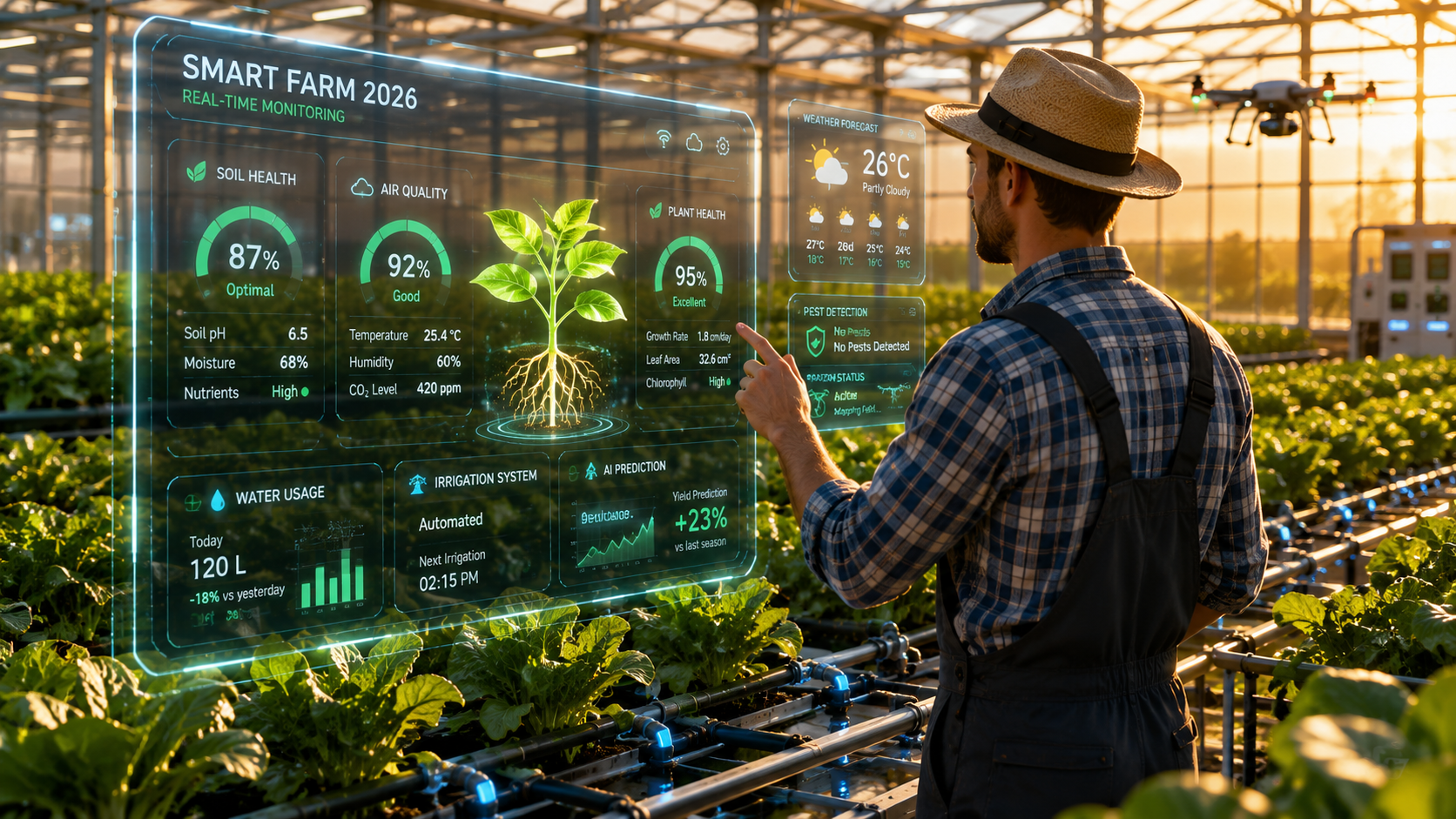
The global agricultural sector in 2026 faces expanding population food demands, volatile climate weather shifts, and severe natural resource constraints. Commercial farming operations, agronomists, and independent farming cooperatives deploy AI in Agriculture 2026 technology pipelines to transition from traditional blanket farming methods to high-precision algorithmic agriculture: leveraging multispectral satellite imagery, computer vision weeding robots, autonomous tractor fleets, and smart IoT irrigation networks to maximize crop yields while reducing herbicide and water usage by up to 40%.
In this technical agritech report on AI in Agriculture 2026, we examine four foundational pillars of modern digital farming: targeted computer vision herbicide spraying, satellite multispectral NDVI crop health monitoring, autonomous robotic harvesting, and soil moisture evapotranspiration models.
Understanding the Shift to Precision Algorithmic Agriculture
For generations, commercial farming relied on uniform field management. Farmers applied identical volumes of water, synthetic fertilizers, and chemical pesticides across entire multi-hundred-acre fields, regardless of localized soil variations or specific crop health conditions. This blanket approach wasted expensive farm inputs, eroded soil biomes, and caused harmful chemical runoff into regional watersheds.
Precision agricultural AI systems operate at the micro-plant level. Computer vision cameras mounted on tractor booms scan individual crop leaves at 30 frames per second, differentiating between commercial crop leaves and invasive weed species in milliseconds. Chemical nozzles actuate micro-doses of herbicide strictly onto targeted weeds, reducing total chemical volume applied by over 80% while preserving beneficial soil microbes.
Leading Agricultural AI Technologies & Platforms Compared
Below is a comparative evaluation matrix measuring leading agritech software platforms across key operational domains:
| Agritech Functional Domain | Underlying AI Technology | Core Operational Benefit | Industry Leading Platforms |
|---|---|---|---|
| Precision Spraying & Laser Weeding | Computer Vision & Micro-Nozzle Actuators | Identifies weeds in real time and micro-sprays herbicide only on weeds, cutting chemical use by 85%. | John Deere See & Spray, Carbon Robotics |
| Satellite Crop Health Monitoring | Multispectral NDVI & Thermal Analytics | Detects fungal infections, nitrogen deficits, and pest attacks days before visible to the naked eye. | Planet Labs, Climate FieldView, Cropin |
| Autonomous Harvesting & Tractors | LiDAR, RTK GPS & Pathfinding Models | Operates 24/7 planting and harvesting with sub-inch spatial accuracy without an onboard driver. | Monarch Tractor, Raven Industries |
| Smart IoT Irrigation Optimization | Soil Moisture Sensors + Weather Prediction | Calculates evapotranspiration rates dynamically to deliver precise water volume per field zone. | Netafim, Arable, Taranis |
| Livestock Health Telemetry | Computer Vision & Acoustic Wearable Sensors | Monitors cattle rumination patterns, body temperature spikes, and lameness signs for early treatment. | CattleEye, Connecterra, CowManager |
1. Targeted Computer Vision Weeding & Herbicide Reduction
Weed management represents one of the largest ongoing expenses in crop production. Weeds compete with commercial crops for sunlight, soil nutrients, and water. Traditional broadcast herbicide application sprays entire fields, accelerating weed chemical resistance and increasing input costs.
Smart tractor implements—such as John Deere See & Spray or Carbon Robotics LaserWeeder—use high-speed GPUs and deep learning convolutional neural networks trained on millions of plant images. As the tractor drives through fields at 12 mph, the AI identifies target weeds and fires high-precision laser bursts or micro-droplet nozzles directly onto weed crowns, leaving surrounding crops untouched. To explore commercial smart farming equipment, visit the official John Deere Smart Farming portal.
2. Multispectral Satellite Imagery & NDVI Health Scouting
Monitoring thousands of acres of crops on foot (field scouting) is labor-intensive and often catches disease outbreaks after widespread damage has already occurred. Satellite constellations equipped with multispectral sensors capture high-resolution images of agricultural fields daily.
AI algorithms calculate Normalized Difference Vegetation Index (NDVI) values by measuring how crop leaves reflect near-infrared light. Healthy, chlorophyll-dense plants reflect high levels of near-infrared light, while stressed or diseased plants absorb it. Machine learning models flag early fungal infections, insect infestations, and nitrogen deficiencies, providing agronomists with precise GPS coordinates for localized treatment before crop yields drop.
3. Autonomous Tractors & Sub-Inch Robotic Harvesting
Agricultural labor shortages present a severe challenge during time-sensitive planting and harvesting windows. Autonomous tractors equipped with LiDAR sensors, RTK GPS receivers, and collision-avoidance neural networks operate continuously without human drivers.
These self-driving machines pull planters, tillers, and harvesters through fields following optimized mathematical pathfinding routes that minimize soil compaction. Sub-inch guidance precision ensures seed placement occurs at exact depth and spacing intervals, optimizing plant population density and sunlight absorption across every row.
4. Smart Irrigation & Predictive Soil Evapotranspiration
Agricultural irrigation consumes over 70% of global freshwater supplies. Traditional timer-based irrigation systems frequently overwater crops, leading to root rot and unnecessary water pumping electricity costs.
Smart AI irrigation platforms combine underground IoT soil moisture telemetry, ambient humidity readings, and hyper-local weather forecasts. The machine learning model calculates daily crop evapotranspiration rates—the exact amount of water lost through plant transpiration and soil evaporation—and actuates drip irrigation valves to deliver the exact volume of water required per soil zone. To learn how renewable energy microgrids power remote farm sensors, read our technical breakdown on AI in renewable energy 2026 systems.
5. AI-Powered Livestock Health & Yield Monitoring
In dairy and beef cattle operations, early disease detection prevents widespread herd infections and improves milk yields. Computer vision cameras installed in barn ceilings monitor cattle gait patterns, detecting early signs of lameness days before visible to herd managers.
Acoustic smart collars track cow rumination chewing sounds and body temperature spikes, alerting farmers to digestive issues or heat stress so veterinary care can be administered early.
Frequently Asked Questions (FAQs)
Q1: Can small-scale family farmers benefit from AI agriculture tools?
Yes! Mobile smartphone applications (like Plantix) use computer vision to diagnose plant diseases, insect damage, and nutrient deficiencies instantly from a phone photo, bringing AI agronomy guidance to smallholder farmers worldwide.
Q2: How does precision AI farming benefit environmental sustainability?
By targeting only specific weeds and diseased plants, precision AI eliminates blanket pesticide spraying, reduces chemical runoff into regional rivers, and conserves millions of gallons of freshwater irrigation resources.
Q3: How do autonomous tractors operate safely around obstacles?
Self-driving tractors combine LiDAR sensors, ultrasonic proximity detectors, and computer vision neural networks that detect animals, vehicles, and humans, bringing the machine to a complete stop instantly if an obstacle enters the safety buffer.
Q4: What is the average Return on Investment (ROI) for smart weeding implements?
Most commercial farm operators recover the initial investment in smart spraying implements within 1 to 2 growing seasons through 80%+ savings in chemical herbicide costs.
Q5: How does AI assist in post-harvest sorting and grading?
High-speed optical sorting machines use computer vision neural networks to inspect harvested fruits and vegetables, sorting produce by size, color, ripeness, and internal defect blemishes at speeds exceeding 50 items per second.
Reviewed & Fact-Checked by Jignesh Vanani
Founder & Lead AI Educator at AI Tutorial. All precision farming architectures, satellite NDVI scouting algorithms, and agritech benchmarks in this AI in Agriculture 2026 guide were evaluated across active farming operations.